
The earliest recorded oil mist fires and crankcase explosions dates back to the genesis of diesel engine development, when Rudolf Diesel himself mentioned the problem in his early writings.
However, it was in 1947, following the MV Reina Del Pacifico disaster in which 28 people died, that the dangers of oil mist gained greater attention, though it wasn’t until the early 1960s that the first crankcase oil mist detector was introduced.
The need to monitor the accumulation of oil mist in an engine’s crankcase and machinery spaces was further recognized when classification reports estimated that between 1990 and 2001 some 700 engines were written off as a consequence of oil mist-based crankcase fires or explosions. P&I Clubs went further claiming that up to 65% of all ship fires were the result of pressurized fuel and lubricating/hydraulic oil droplets collecting in the atmosphere of machinery spaces.
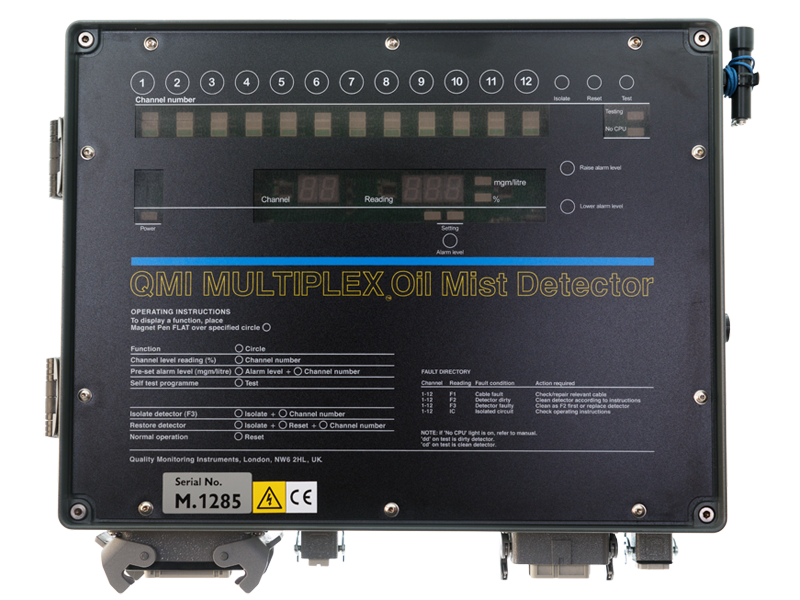
QMI Multiplex Monitor (Q01H)
- Provides rapid 500 millisecond response times when the detectors are correctly mounted.
- Can monitor up to 12 detection points simultaneously.
- Can be mounted in the engine control rooms or on the bridge away from danger zones.
- Does not require a pressure regulator or heater to deal with condensation.
- Measures oil mist at source and does not have to travel along pipes, which delays response times.
- Does not require clean compressed air.
- Provides early warning and main alarm together with an engine shut/slowdown facility.
- Features a self-diagnostic fault finding capability to indicate instrument faults.
- Faults are displayed on the monitor so that the user is kept informed and need not fear false alarms.
- Will work even when one of the detectors has developed a problem.
- Can oversee more than one engine; monitor oil mist in the atmosphere around the plant, at the same time enabling detection of hazards before fires start.
- Is able to assess gearbox bearings together with the pistons and external surrounds for oil mist.
Technology
Benefits
Sources of ignition
Configuration
This fine, highly flammable mist of between 1 and 10µm is produced at surface temperatures of between 200°C and 600°C, while droplets greater than 50µm are typically produced from pinhole leaks in a pressure line.
In an open machinery space, oil mist or spray of any droplet size must be treated as a potential fire risk and appropriate detection systems should be in place to safeguard ships’ crew and equipment before it becomes a MAIB incident.
The principle used in the early oil mist detection systems – obscuration light absorption – is still used by most manufacturers of oil mist detection systems to this day. The technology involves the extraction of the oil mist from selected points within the crankcase which is then transferred in sequence via discrete pipes to a central detector, usually mounted on the engine, with a facility for remote reading at a centralised panel.
However, these systems have a very slow response time which, in some cases, raises alarm after engine seizure or explosion has actually taken place.
When the lenses become obscured a false alarm can occur.
To provide 100% oil mist detection accuracy and reliability, QMI systems use a proprietary light scatter (nephelometry) technology proven to:
-
- Eliminate false alarms
- Deliver rapid readings within 500 milliseconds of oil mist being detected
- Eliminate unnecessary pipework
- Allow for linear output (true zero)
- Quantify oil mist in mg/l
- Allow for up to 50% lens obscurity
- Allow for detector calibration
- Allow the use of smaller detectors
- Allow for optimum placement of detectors
- Monitor the condition of the engine
- Leaking injectors
- Fractured flexible hoses
- Loose or incorrectly fitted pipe fittings
- Broken welds
- Poor maintenance of machinery and pipe work
Exemplary system configuration:
Option 1 Atmospheric oil mist detection systems with 12 channels:
QMI MULTIPLEX monitor up to 12-channel measurable (Q01H)*
QMI atmospheric sensor(s) – the number of devices required depends on the rooms to be monitored and the ventilation installed. (Q10)*
QMI connection box (Q07)
Maintenance kit (Q1005)
Many configurations of key components are available to suit any application. Additional extras include:
Data logger output – which provides the ability to send data to a main alarm control panel
Individual or group shutdowns (MULIPLEX only) – where the system can be programmed to shut down a single or multiple areas.
Option 2 motors Oil mist detection systems with 12 channels:
QMI MULTIPLEX monitor up to 12-channel measurable (Q01H)*
QMI engine sensor – The number required depends on the number of crankcases to be monitored. (Q02L)*
QMI connection box (Q06)
Maintenance kit (Q0215)
Fan (Q03FH)
Added extras include:
Data logger output
Modbus output
Individual or grouped shutdowns